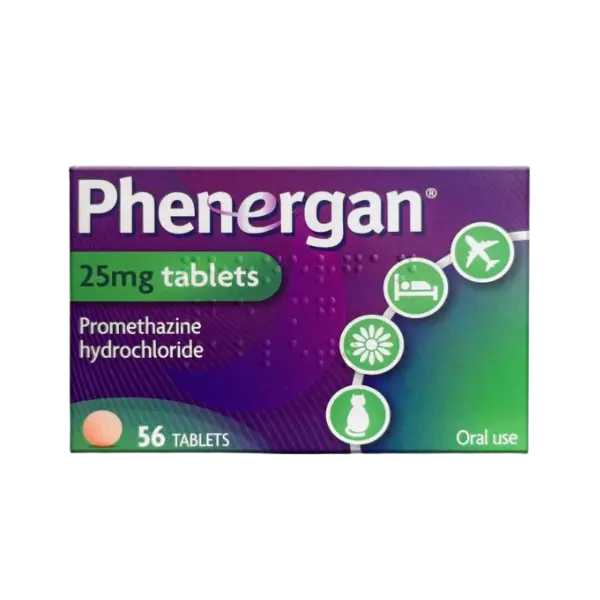
Phenergan Tablets
Versatile antihistamine for allergies, travel sickness, and sleep aid.
- Relieves allergy symptoms
- Effective for nausea and vomiting
- Useful for motion sickness prevention
- Provides quick symptom relief
- Enhances comfort during travel
| Active Ingredient | — |
| Strength | — |
| Size | — |
| Flavour | — |
Overview
How does Phenergan Tablets provide relief from allergic reactions and nausea?
Phenergan Tablets contains the active ingredient promethazine hydrochloride, which belongs to a group of medicines called phenothiazines. Phenergan Tablets acts as a sedating antihistamine by blocking the H1 receptors in the body, which prevents the action of histamine—a chemical released during an allergic response. By inhibiting this pathway, Phenergan Tablets effectively reduces symptoms such as sneezing, itching, and watery eyes. Furthermore, Phenergan Tablets possesses significant anti-emetic properties, meaning Phenergan Tablets works on the vomiting centre in the brain to prevent and treat nausea and vomiting, including motion sickness. Phenergan Tablets also crosses the blood-brain barrier to produce a sedative effect, making Phenergan Tablets useful for the short-term management of insomnia in adults.
What are the benefits of the multi-functional action in Phenergan Tablets?
The primary benefit of Phenergan Tablets is the versatility of Phenergan Tablets in treating a diverse range of conditions with a single dose. Because Phenergan Tablets combines antihistamine, anti-emetic, and sedative effects, Phenergan Tablets is particularly beneficial for individuals whose allergies are severe enough to disrupt sleep. Unlike non-drowsy antihistamines, the sedative nature of Phenergan Tablets helps to calm the central nervous system, providing relief from the agitation associated with intense pruritus or itching. Additionally, the long-acting nature of Phenergan Tablets ensures that the therapeutic effects of promethazine hydrochloride persist for several hours, offering sustained comfort throughout the night or during long journeys where travel sickness may occur.
How does Phenergan Tablets assist in managing short-term sleep disturbances?
Short-term insomnia often occurs due to temporary stress, travel, or physical discomfort, and Phenergan Tablets assists by inducing a state of relaxation. The promethazine hydrochloride in Phenergan Tablets interferes with the neurotransmitters in the brain that maintain wakefulness, thereby facilitating the onset of sleep. When taken before bedtime, Phenergan Tablets helps the user fall asleep more quickly and stay asleep longer. Because Phenergan Tablets is intended for short-term use, Phenergan Tablets provides a useful intervention for resetting sleep patterns without the immediate risk of dependency associated with some prescription hypnotics. The calming effect of Phenergan Tablets also makes Phenergan Tablets a suitable option for mild sedation before minor medical or dental procedures.
Active Ingredients
Promethazine Hydrochloride
Usage Instructions
How should Phenergan Tablets be administered for maximum efficacy?
The dosage of Phenergan Tablets depends on the condition being treated and the age of the patient. For allergic conditions, adults typically take Phenergan Tablets at night, though the frequency may be adjusted by a healthcare professional if necessary. For the short-term treatment of insomnia, the dose of Phenergan Tablets should be taken at bedtime. For travel sickness, the dose of Phenergan Tablets should be taken the night before the journey, with an additional dose if required the following morning. Each Phenergan Tablets should be swallowed whole with water and can be taken with or after food. Because Phenergan Tablets causes significant drowsiness, users should ensure they have adequate time for a full night’s sleep to avoid morning grogginess.
Warnings
What safety precautions must be followed when using Phenergan Tablets?
Phenergan Tablets must not be used by individuals with a known hypersensitivity to promethazine or other phenothiazines. Phenergan Tablets is not suitable for those taking monoamine oxidase inhibitors (MAOIs) or for individuals with narrow-angle glaucoma or prostate hypertrophy. Phenergan Tablets causes significant drowsiness; therefore, users must not drive, operate machinery, or perform hazardous tasks until they are certain the effects of Phenergan Tablets have worn off. Alcohol must be strictly avoided as it increases the sedative effects of Phenergan Tablets. Pregnant or breastfeeding women should consult a doctor before taking Phenergan Tablets. Phenergan Tablets can make the skin more sensitive to sunlight, so excessive sun exposure should be avoided.
Who Is It For
Who is the intended user for Phenergan Tablets?
Phenergan Tablets is intended for use by adults and children aged 5 years and over. Phenergan Tablets is suitable for individuals suffering from allergic rhinitis, hay fever, hives, or insect bites. Phenergan Tablets is also an appropriate choice for those experiencing nausea, vertigo, or motion sickness. Furthermore, adults seeking a short-term sedative to aid with sleep may use Phenergan Tablets. Phenergan Tablets must not be used by children under the age of 2 years due to the risk of fatal respiratory depression.
Alternatives
What are the common alternatives to Phenergan Tablets?
If Phenergan Tablets is not suitable or a non-sedating effect is required, the following alternatives may be considered:
-
Piriton Tablets: Contains chlorphenamine, another sedating antihistamine often used for shorter-term allergy relief.
-
Cetirizine Tablets: A second-generation, non-drowsy antihistamine suitable for daily management of hay fever.
-
Sominex Tablets: Specifically marketed as a sleep aid, containing promethazine to induce drowsiness.
-
Avomine Tablets: Contains promethazine teoclate, specifically formulated for the prevention and treatment of travel sickness.
At Elite Meds, we provide simple, reliable and fast delivery for all orders. We use Royal Mail exclusively, based on consistent performance and strong customer satisfaction across our website and eBay stores.
Delivery Options
Royal Mail Tracked 48 – £3.99
Royal Mail Tracked 24 – £4.49
Delivery timeframes are estimates provided by Royal Mail and are not guaranteed.
Dispatch Times
- Orders placed before 3pm Monday to Friday are dispatched the same working day.
- Orders placed after 3pm, on weekends or bank holidays are dispatched the next working day.
See our full delivery policy here
You May Like These
View All




Reviews (0.0/5 stars based on 0 reviews)
There are no reviews yet.