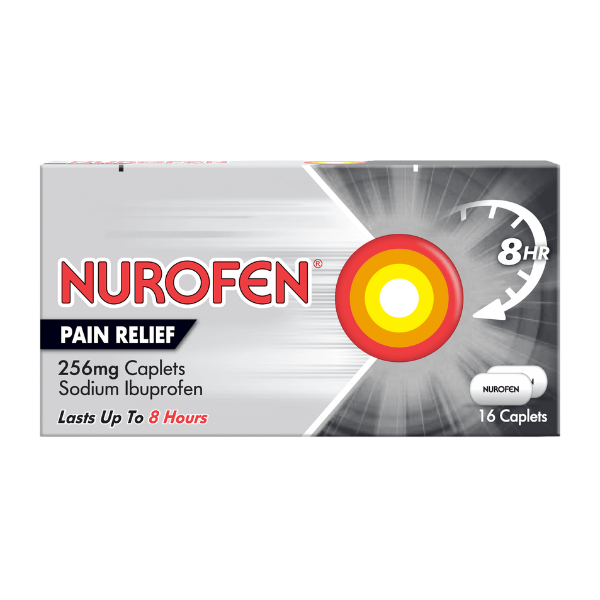
Nurofen Caplets
Effective relief from pain and inflammation
- Reduces Inflammation
- Long-Lasting Relief
- Reduces Fever
- Easy to Swallow
- Fast Acting
| Active Ingredient | — |
| Strength | — |
| Size | — |
| Flavour | — |
Overview
How do Nurofen Caplets work to relieve pain and inflammation?
Nurofen Caplets contain the active ingredient ibuprofen, which belongs to a class of medicines known as non-steroidal anti-inflammatory drugs or NSAIDs. To understand how Nurofen Caplets work, it is necessary to understand the body’s natural response to injury. When tissues are damaged or infected, the body produces an enzyme called cyclooxygenase. This enzyme is responsible for the production of prostaglandins, which are lipid compounds that act as chemical messengers. Prostaglandins cause the nerve endings to become sensitive to pain, trigger swelling in the tissues, and raise the body’s temperature to create a fever.
Nurofen Caplets work by inhibiting or blocking the action of the cyclooxygenase enzyme. By preventing the production of prostaglandins, Nurofen Caplets effectively interrupt the pain signal at the source and reduce the physical inflammation in the affected area. This dual action makes Nurofen Caplets different from simple analgesics like paracetamol, which primarily treat pain signals in the brain but have little effect on inflammation at the site of injury.
What is the advantage of the Caplet format in Nurofen?
The term “caplet” refers to the specific physical design of the medication. Nurofen Caplets are shaped like an oval capsule but are solid like a tablet. They are coated with a smooth film, which facilitates easier swallowing compared to traditional round, chalky tablets. This design is particularly beneficial for individuals who experience dysphagia, or difficulty swallowing, and allows the medication to reach the stomach efficiently.
What specific conditions do Nurofen Caplets treat?
Nurofen Caplets are clinically indicated for the relief of mild to moderate pain, particularly where inflammation is a contributing factor. Nurofen Caplets are highly effective for treating dental pain, migraines, and tension headaches. They are also the recommended first-line treatment for primary dysmenorrhoea, or period pain, because they target the specific prostaglandins in the womb lining that cause cramping. Additionally, Nurofen Caplets provide relief from musculoskeletal conditions such as backache, rheumatic pain, neuralgia, and soft tissue injuries like sprains and strains. Nurofen Caplets also act as an antipyretic to lower high temperatures associated with colds and influenza.
Active Ingredients
Sodium Ibuprofen
Usage Instructions
How to take Nurofen Caplets correctly?
Nurofen Caplets should be swallowed whole with a full glass of water. Users must not chew, crush, or suck the caplets, as this can damage the protective coating and release the active ingredient too early, potentially causing mouth or throat irritation.
Adults and children aged 12 years and over: The recommended dose is 1 or 2 caplets taken every 4 to 6 hours as required.
Why must Nurofen Caplets be taken with food?
It is critical that Nurofen Caplets are taken with food or immediately after a meal. Ibuprofen acts systematically but can be locally irritating to the gastric mucosa, which is the lining of the stomach. Taking Nurofen Caplets on an empty stomach increases the risk of acid indigestion, nausea, and gastric pain. In severe cases, taking NSAIDs without food can lead to the development of gastric ulcers or bleeding. Food acts as a buffer, protecting the stomach wall from these adverse effects.
What are the dosage limits? Users must strictly adhere to the dosage limits to avoid toxicity. The maximum dose is 6 caplets in any 24-hour period, which equates to 1200mg of ibuprofen. Nurofen Caplets are intended for short-term use only. Users should not take Nurofen Caplets for longer than 3 days. If symptoms persist beyond this period, it may indicate a more serious underlying condition or infection that requires medical assessment.
Warnings
When must Nurofen Caplets not be used?
Nurofen Caplets must not be used by patients who have active peptic ulcers, which are open sores on the lining of the stomach or duodenum, or by those with a history of recurrent stomach bleeding. Nurofen Caplets are not suitable for individuals with severe heart failure, kidney failure, or liver failure, as NSAIDs can impair the function of these organs. Nurofen Caplets must not be taken by anyone who has previously experienced a hypersensitivity reaction to ibuprofen, aspirin, or other NSAIDs. Signs of such a reaction include asthma attacks, bronchospasm, rhinitis, or urticaria, which is an itchy skin rash.
Safety advice regarding pregnancy and fertility?
Nurofen Caplets must not be taken during the last three months of pregnancy, known as the third trimester. During this period, ibuprofen can cause serious heart and kidney problems in the unborn baby and may lead to prolonged bleeding during labour. Women in the first six months of pregnancy should only use Nurofen Caplets if explicitly advised by a doctor. Additionally, there is some evidence that NSAIDs like Nurofen Caplets may temporarily impair female fertility by affecting ovulation, though this is reversible upon stopping the medication.
Potential medication interactions?
Nurofen Caplets can interact significantly with other medications. They should not be taken alongside other NSAIDs or aspirin, as this increases the cumulative risk of stomach side effects without providing extra pain relief. Nurofen Caplets can reduce the effectiveness of anti-hypertensive medicines used to treat high blood pressure. Patients taking anticoagulants, such as warfarin, must avoid Nurofen Caplets as the combination greatly increases the risk of haemorrhage. Nurofen Caplets may also increase the toxicity of methotrexate and lithium.
Who Is It For
Who are Nurofen Caplets suitable for?
Nurofen Caplets are suitable for adults and children aged 12 years and over. They are an ideal choice for individuals seeking relief from pain accompanied by swelling, redness, or heat, which are signs of inflammation. Nurofen Caplets are not suitable for children under 12 years of age. For this younger demographic, specific paediatric liquid suspensions are available that allow for more accurate weight-based dosing.
Alternatives
Common alternatives to Nurofen Caplets?
If Nurofen Caplets are not suitable due to stomach sensitivity, asthma, or medical history, common alternatives include:
- Panadol Advance Tablets: Contains paracetamol, which provides effective pain and fever relief without irritating the stomach lining or affecting blood clotting mechanisms.
- Nurofen Express Liquid Capsules: Contains ibuprofen in a solubilised liquid format encapsulated in gelatin, which allows for faster absorption into the bloodstream for quicker onset of action.
- Voltarol 12 Hour Joint Pain Relief Gel: A topical formulation containing diclofenac diethylammonium, which is applied directly to the skin to treat local pain and inflammation with minimal absorption into the rest of the body.
- Co-codamol: A combination of paracetamol and codeine, used for acute moderate pain that is not relieved by ibuprofen or paracetamol alone, though it carries a risk of drowsiness.
At Elite Meds, we provide simple, reliable and fast delivery for all orders. We use Royal Mail exclusively, based on consistent performance and strong customer satisfaction across our website and eBay stores.
Delivery Options
Royal Mail Tracked 48 – £3.99
Royal Mail Tracked 24 – £4.49
Delivery timeframes are estimates provided by Royal Mail and are not guaranteed.
Dispatch Times
- Orders placed before 3pm Monday to Friday are dispatched the same working day.
- Orders placed after 3pm, on weekends or bank holidays are dispatched the next working day.
See our full delivery policy here
You May Like These
View All

Reviews (0.0/5 stars based on 0 reviews)
There are no reviews yet.