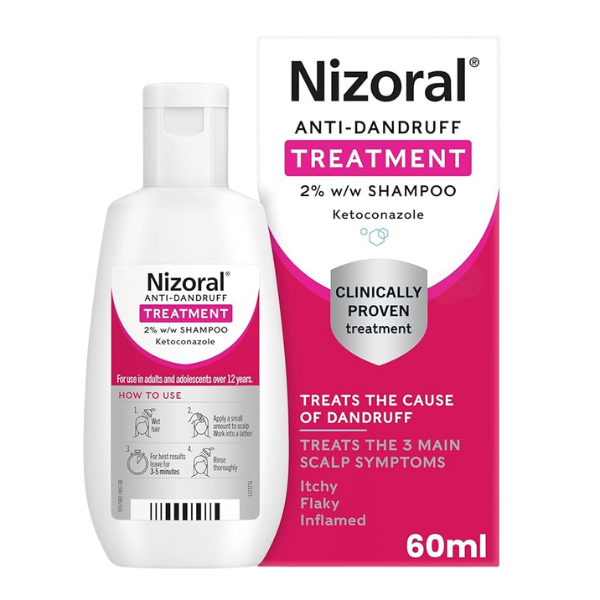
Nizoral Anti-Dandruff Shampoo
Dandruff treatment shampoo
- Treats and prevents dandruff
- Visible results in only 2 weeks
- Treats the root cause of dandruff
- Fragrance free
- Suitable for all hair types
| Active Ingredient | — |
| Strength | — |
| Size | — |
| Flavour | — |
Clinically Proven Treatment for Dandruff and Seborrhoeic Dermatitis
Nizoral Anti-Dandruff Shampoo Overview
Nizoral Anti-Dandruff Shampoo is a medicated antifungal shampoo used to treat persistent dandruff and seborrhoeic dermatitis. It contains ketoconazole, which targets the yeast responsible for scalp flaking, itching and inflammation.
In the UK, Nizoral Shampoo is an over-the-counter pharmacy medicine, commonly recommended when standard cosmetic anti-dandruff shampoos have failed to control symptoms.
Understanding Dandruff and Scalp Conditions
What causes dandruff
Dandruff is commonly associated with an overgrowth of Malassezia yeast, which naturally lives on the scalp. In some people, this yeast triggers inflammation, leading to flaking, itching and irritation.
Seborrhoeic dermatitis is a more severe form of this process and may cause redness, greasy scaling and discomfort, particularly around the scalp, hairline and eyebrows.
Why targeted treatment matters
Cosmetic shampoos may help mild flaking, but persistent dandruff often requires antifungal treatment to address the underlying cause rather than just removing flakes.
What Is Nizoral Anti-Dandruff Shampoo?
Nizoral Shampoo contains ketoconazole, a broad-spectrum antifungal medicine. It is designed to treat the cause of dandruff by reducing yeast levels on the scalp rather than masking symptoms.
Because it targets inflammation and yeast overgrowth, Nizoral is often used when dandruff is recurrent, itchy or difficult to control.
How Does Nizoral Work?
Antifungal action
Ketoconazole works by interfering with ergosterol synthesis, an essential component of fungal cell membranes. This damages the yeast cells and reduces their ability to survive and multiply.
Reducing inflammation and flaking
By lowering yeast levels, Nizoral helps reduce scalp inflammation, itching and excessive skin shedding, allowing the scalp to return to a healthier balance.
What Nizoral Helps With — and What It Does Not
What it helps with
Nizoral Anti-Dandruff Shampoo is used to treat:
- dandruff
- seborrhoeic dermatitis of the scalp
- scalp flaking and scaling
- itching associated with fungal scalp conditions
It is effective when used as directed for the recommended treatment course.
What it does not treat
Nizoral does not:
- cure non-fungal scalp conditions
- treat psoriasis of the scalp
- provide instant results
- replace medical assessment for severe scalp disease
Improvement usually occurs over several weeks of correct use.
Nizoral Anti-Dandruff Shampoo Summary
Nizoral Anti-Dandruff Shampoo provides effective antifungal treatment for persistent dandruff and seborrhoeic dermatitis. By targeting the yeast responsible for scalp inflammation and flaking, it helps restore scalp health when used correctly.
Persistent or severe scalp symptoms should always be assessed by a healthcare professional.
Active Ingredients
Ketoconazole
How to Use Nizoral Anti-Dandruff Shampoo
Apply to wet hair and massage into the scalp. Leave the shampoo on the scalp for 3–5 minutes before rinsing thoroughly.
It is usually used twice weekly for 2–4 weeks, then less frequently to prevent recurrence, depending on response.
Safety, Warnings and Side Effects
Nizoral is generally well tolerated. Mild scalp irritation, dryness or changes in hair texture may occur, particularly during early use.
If severe irritation develops, stop use and seek advice.
When to Seek Medical Advice
Speak to a GP or pharmacist if:
- symptoms do not improve after 4 weeks
- dandruff returns quickly after treatment
- there is significant redness, pain or hair loss
- the diagnosis is uncertain
Further investigation or alternative treatment may be needed.
Use in Pregnancy and Breastfeeding
Topical ketoconazole shampoo is generally considered low risk, but Nizoral should be used during pregnancy or breastfeeding on professional advice.
Who Is Nizoral Shampoo For?
Nizoral may be suitable for:
- adults with persistent dandruff
- people with itchy, flaky scalp not responding to regular shampoos
- individuals with seborrhoeic dermatitis
A pharmacist can help confirm whether symptoms are likely to be fungal in origin.
Who Should Avoid Nizoral
Nizoral Shampoo should not be used if:
- you are allergic to ketoconazole
- the scalp is severely broken or infected without advice
Avoid contact with eyes and mucous membranes.
How Nizoral Compares to Other Anti-Dandruff Shampoos
Nizoral vs cosmetic anti-dandruff shampoos
Cosmetic shampoos help remove flakes but do not treat fungal overgrowth. Nizoral targets the underlying cause of dandruff.
Nizoral vs selenium sulphide
Both are antifungal. Ketoconazole is often preferred due to tolerability and targeted yeast action.
At Elite Meds, we provide simple, reliable and fast delivery for all orders. We use Royal Mail exclusively, based on consistent performance and strong customer satisfaction across our website and eBay stores.
Delivery Options
Royal Mail Tracked 48 – £3.99
Royal Mail Tracked 24 – £4.49
Delivery timeframes are estimates provided by Royal Mail and are not guaranteed.
Dispatch Times
- Orders placed before 3pm Monday to Friday are dispatched the same working day.
- Orders placed after 3pm, on weekends or bank holidays are dispatched the next working day.
See our full delivery policy here

Reviews (0.0/5 stars based on 0 reviews)
There are no reviews yet.