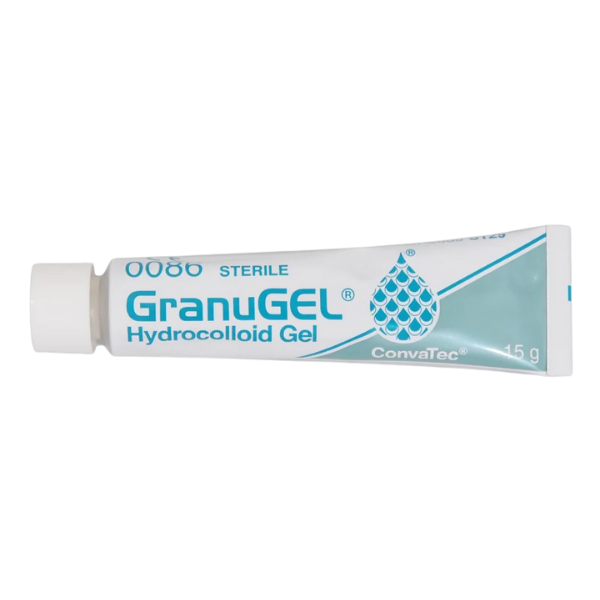
Granugel Hydrocolloid Gel (15g)
Moist wound gel to donate moisture and support healing
- Promotes healing of chronic and acute wounds
- Maintains a moist environment to support tissue repair
- Helps remove dead tissue and reduce scarring
- Non-sticky, easy-to-apply gel for comfort
- Suitable for use on ulcers, burns, and pressure sores
£3.99 Available Free Delivery on Orders over £20!
In stock
| Size | 15 g |
Overview
How does Granugel Hydrocolloid Gel (15g) facilitate autolytic debridement?
Granugel Hydrocolloid Gel is a sterile, viscous gel designed to manage partial and full-thickness wounds by regulating the wound environment. The primary function of Granugel Hydrocolloid Gel is to promote autolytic debridement. This is a natural process where the body’s own enzymes break down dead (necrotic) tissue and slough. By donating moisture to dry, necrotic tissue, Granugel Hydrocolloid Gel rehydrates hard eschar, softening it so that it can be separated from the healthy tissue beneath. Simultaneously, the hydrocolloid component (pectin and carboxymethylcellulose) absorbs excess exudate from the wound. This balance prevents the wound from drying out (desiccation) while minimising the risk of the surrounding skin becoming soggy (maceration), creating the optimal moist conditions required for healing.
How does Granugel Hydrocolloid Gel (15g) support granulation tissue?
Once the wound is clean of debris, Granugel Hydrocolloid Gel continues to support the healing process by protecting the fragile new tissue known as granulation tissue. Granulation tissue is rich in blood vessels and collagen, appearing red and bumpy. Granugel Hydrocolloid Gel acts as a filler for deep cavity wounds, ensuring there is no “dead space” where bacteria could proliferate. By maintaining a moist interface, Granugel Hydrocolloid Gel prevents dressings from sticking to the wound bed. This ensures that when the dressing is changed, the delicate new cells are not torn away, thereby reducing pain and trauma for the patient during maintenance.
What is the pH balance role of Granugel Hydrocolloid Gel (15g)?
Granugel Hydrocolloid Gel is formulated to maintain a slightly acidic pH environment (around pH 6.0). A slightly acidic wound environment is beneficial because it helps to inhibit the growth of certain bacteria and favours the activity of the enzymes responsible for healing and collagen formation.
Usage Instructions
How to apply Granugel Hydrocolloid Gel (15g) correctly?
Proper application is essential to ensure debridement without damaging healthy skin.
- Preparation: The wound site should be cleansed thoroughly with sterile saline or water and the surrounding skin patted dry.
- Application: The nozzle of the Granugel Hydrocolloid Gel tube should be cleansed with an antiseptic wipe before use. Granugel Hydrocolloid Gel should be applied directly into the wound cavity.
- Depth: Granugel Hydrocolloid Gel should not be filled flush to the surface; instead, the wound should be filled only to about two-thirds of its depth, as Granugel Hydrocolloid Gel may expand slightly as it absorbs fluid.
- Dressing: Granugel Hydrocolloid Gel must be covered with a secondary dressing. For necrotic wounds, a moisture-retentive dressing (like Granuflex) is often used. For wetter wounds, an absorbent pad may be required.
- Frequency: Granugel Hydrocolloid Gel should be changed when the secondary dressing leaks or is changed, typically every 1 to 3 days depending on the level of exudate.
Warnings
When must Granugel Hydrocolloid Gel (15g) be used with caution?
Granugel Hydrocolloid Gel must not be used on patients with a known sensitivity to the gel or its components (propylene glycol, pectin, carboxymethylcellulose). Granugel Hydrocolloid Gel is not suitable for extensive burns. If clinical signs of infection are present (fever, increased pain, redness, spreading heat), Granugel Hydrocolloid Gel may still be used, but only under strict medical supervision and alongside appropriate systemic antibiotic therapy.
Who Is It For
Who is Granugel Hydrocolloid Gel (15g) suitable for?
Granugel Hydrocolloid Gel is suitable for patients with chronic or acute wounds that contain slough (yellow, moist dead tissue) or necrosis (black, dry dead tissue). Granugel Hydrocolloid Gel is specifically indicated for the management of pressure ulcers (bedsores), venous leg ulcers, and diabetic foot ulcers. Granugel Hydrocolloid Gel is also an ideal choice for treating surgical wounds that are healing by secondary intention (left open to heal from the bottom up) and for minor burns or scalds where maintaining moisture is critical for pain relief and healing.
Alternatives
Common alternatives to Granugel Hydrocolloid Gel (15g)?
If Granugel Hydrocolloid Gel is not suitable due to availability or specific wound requirements, common alternatives include:
- Intrasite Gel: A widely used amorphous hydrogel containing propylene glycol, excellent for rehydrating necrotic tissue and highly effective for debridement.
- Purilon Gel: A viscous hydrogel combining sodium carboxymethylcellulose and calcium alginate, offering high cohesion and absorption properties for sloughy wounds.
- Nu-Gel Hydrogel: Contains alginate to help manage exudate while providing moisture, often used for wounds with low to moderate fluid levels.
- Flaminal Hydro / Forte: An enzyme alginogel that offers antimicrobial protection (using enzymes) alongside the moisture balance functions of a standard hydrogel.
- Activon Tube Manuka Honey: Uses medical-grade honey to promote debridement through an osmotic effect and provides natural antimicrobial action, suitable for infected wounds.
At Elite Meds, we provide simple, reliable and fast delivery for all orders. We use Royal Mail exclusively, based on consistent performance and strong customer satisfaction across our website and eBay stores.
Delivery Options
Royal Mail Tracked 48 – £3.99
Royal Mail Tracked 24 – £4.49
Delivery timeframes are estimates provided by Royal Mail and are not guaranteed.
Dispatch Times
- Orders placed before 3pm Monday to Friday are dispatched the same working day.
- Orders placed after 3pm, on weekends or bank holidays are dispatched the next working day.
See our full delivery policy here
You May Like These
View All



Reviews (0.0/5 stars based on 0 reviews)
There are no reviews yet.