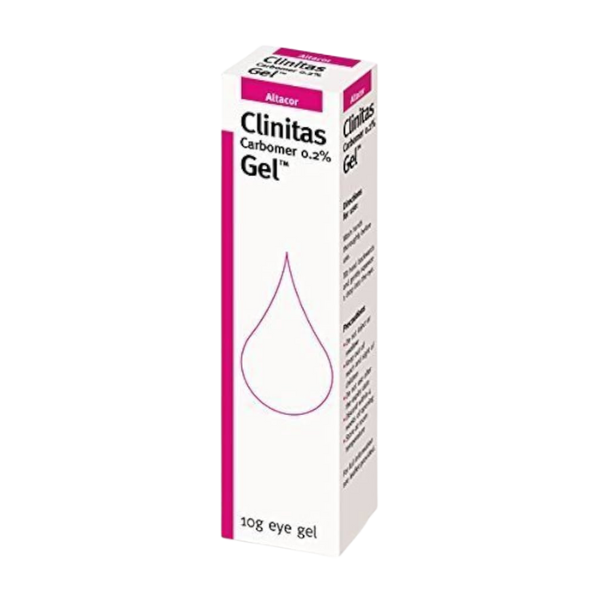
Clinitas Carbomer Gel 0.2% 10g
Soothing gel for dry, irritated eyes
- Provides long-lasting relief from dry, irritated, or gritty eyes
- Lubricates and protects the eye surface by forming a soothing film
- Contains carbomer to maintain moisture and comfort
- Ideal for daytime and nighttime use
- Suitable for contact lens wearers when lenses are removed
£2.19 Available Free Delivery on Orders over £20!
In stock
| Strength | 0.2% |
| Size | 10 g |
Overview
How does Clinitas Carbomer Gel biologically replicate the natural tear film?
Clinitas Carbomer Gel is a “liquid gel” formulation designed to function as a synthetic substitute for the aqueous (water) layer of the natural tear film. The primary active ingredient is Carbomer 980, a high molecular weight hydrophilic polymer. In the human eye, the tear film is composed of three distinct layers: the inner mucin layer that coats the cornea, the middle aqueous layer that provides hydration, and the outer lipid layer that prevents evaporation. When Clinitas Carbomer Gel is applied, the carbomer molecules entrap water within their cross-linked structure, holding up to six times their own volume in moisture. This structural capacity allows Clinitas Carbomer Gel to significantly boost the volume of the aqueous layer, effectively rehydrating the corneal surface and alleviating the friction caused by aqueous-deficient dry eye.
What is the role of the mucoadhesive polymer in Clinitas Carbomer Gel?
A critical pharmacological advantage of Clinitas Carbomer Gel over standard saline eye drops is its “residence time” or retention on the ocular surface. The Carbomer 980 polymer possesses bio-adhesive properties, meaning it physically clings to the mucin layer on the surface of the eye. While standard watery drops drain through the tear ducts within minutes, the viscous structure of Clinitas Carbomer Gel resists gravity and blink-induced drainage. This allows the gel to remain in contact with the cornea for a prolonged period, typically providing relief for 4 to 6 hours. This extended contact time is vital for healing micro-abrasions on the corneal epithelium caused by persistent dryness.
How does the phase-transition property affect vision?
Clinitas Carbomer Gel is described as a liquid gel because it exhibits thixotropic properties. In the tube, Clinitas Carbomer Gel is a semi-solid gel, which makes it easy to control during application. However, upon contact with the salt content of the tears and the shear force created by blinking, the gel structure thins and spreads rapidly across the eye surface. This transition ensures that while the gel is thick enough to provide long-lasting lubrication, it eventually smooths out to minimise visual disruption, although an initial blurring is expected due to the high viscosity.
What specific conditions does Clinitas Carbomer Gel treat?
Clinitas Carbomer Gel is clinically indicated for the symptomatic treatment of “dry eye” conditions, medically known as keratoconjunctivitis sicca. It is particularly effective for “evaporative” dry eye caused by environmental factors such as air conditioning, central heating, or high winds. Furthermore, Clinitas Carbomer Gel is highly recommended for individuals experiencing “Computer Vision Syndrome”. During intense screen use, the spontaneous blink rate drops significantly, leading to tear film instability. Clinitas Carbomer Gel compensates for this reduced blinking by maintaining a stable moisture barrier over the exposed eye surface.
Active Ingredients
Carbomer
Usage Instructions
How to apply Clinitas Carbomer Gel correctly?
Clinitas Carbomer Gel is for ocular use only.
- Hygiene: Hands must be washed thoroughly before use.
- Preparation: Remove the cap from the tube. Tilt the head backwards and gently pull the lower eyelid downwards to create a small pocket (the conjunctival fornix).
- Application: Hold the tube vertically above the eye. Squeeze the tube gently to release one drop into the pocket.
- Precautions: Do not touch the tip of the tube to the eye, eyelashes, or eyelids, as this can contaminate the sterile gel inside.
- Dispersion: Release the eyelid and blink several times to spread Clinitas Carbomer Gel 0.2% 10g evenly across the surface of the eye.
- Frequency: The recommended dose is one drop instilled into the affected eye(s) 3 to 4 times a day, or as required.
Can Clinitas Carbomer Gel be used with contact lenses?
Clinitas Carbomer Gel contains a preservative called cetrimide. This preservative can be absorbed by soft contact lenses, leading to discolouration of the lens and potential irritation to the cornea. Therefore, contact lenses must be removed before applying Clinitas Carbomer Gel. Users should wait for at least 30 minutes after application before re-inserting their lenses.
Warnings
When must Clinitas Carbomer Gel not be used?
Clinitas Carbomer Gel must not be used by patients with a known hypersensitivity to Carbomer 980, cetrimide, or any of the other excipients. Due to the viscosity of the gel, Clinitas Carbomer Gel causes temporary blurred vision immediately after application. Users must not drive or operate machinery until their vision has completely cleared. Clinitas Carbomer Gel 0.2% 10g should be discarded 28 days after first opening the tube to prevent the risk of infection.
What are the signs of an allergic reaction to Clinitas Carbomer Gel?
Although rare, some users may react to the cetrimide preservative. If the user experiences increased redness, stinging that does not subside, or swelling of the eyelids after using Clinitas Carbomer Gel, use should be discontinued immediately and medical advice sought.
Who Is It For
Who is Clinitas Carbomer Gel suitable for?
Clinitas Carbomer Gel is suitable for adults, the elderly, and children. It is specifically designed for individuals suffering from moderate to severe dry eye sensations, such as grittiness, burning, or a “sand in the eye” feeling. Clinitas Carbomer Gel is an ideal choice for patients who find that standard eye drops do not last long enough and require a more viscous solution to get through the day or night. Clinitas Carbomer Gel is suitable for women experiencing hormonal dry eye during menopause.
Alternatives
Common alternatives to Clinitas Carbomer Gel?
If Clinitas Carbomer Gel is not suitable due to the preservative content or viscosity, common alternatives include:
- Clinitas Soothe (0.4% Sodium Hyaluronate): A preservative-free drop in single-dose units that uses sodium hyaluronate to hydrate the eye, suitable for use with contact lenses without removal.
- Viscotears Liquid Gel: A well-known brand containing the same Carbomer 980 (0.2%) and cetrimide formulation as Clinitas Carbomer Gel 0.2% 10g, working via the exact same mechanism.
- Artelac Nighttime Gel: Contains carbomer and is often used specifically for overnight protection, though the formulation is very similar to Clinitas Carbomer Gel 0.2% 10g.
- Xailin Gel: Another carbomer-based lubricant that uses a “disappearing preservative” (sodium perborate) which converts to water and oxygen on contact with the eye, making it gentler than the cetrimide in Clinitas Carbomer Gel 0.2% 10g.
At Elite Meds, we provide simple, reliable and fast delivery for all orders. We use Royal Mail exclusively, based on consistent performance and strong customer satisfaction across our website and eBay stores.
Delivery Options
Royal Mail Tracked 48 – £3.99
Royal Mail Tracked 24 – £4.49
Delivery timeframes are estimates provided by Royal Mail and are not guaranteed.
Dispatch Times
- Orders placed before 3pm Monday to Friday are dispatched the same working day.
- Orders placed after 3pm, on weekends or bank holidays are dispatched the next working day.
See our full delivery policy here
You May Like These
View All




Reviews (0.0/5 stars based on 0 reviews)
There are no reviews yet.