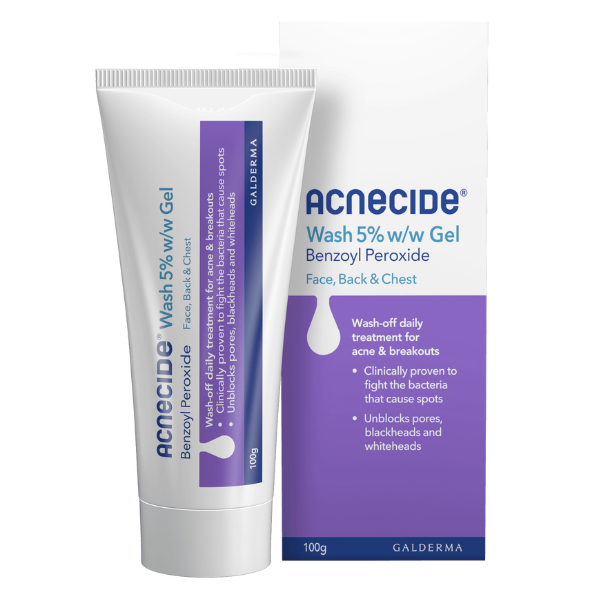
Acnecide Wash 5% w/w Gel (100g)
Daily benzoyl peroxide wash to reduce spots and breakouts
- Effectively treats acne by targeting bacteria and excess oil
- Contains benzoyl peroxide to unclog pores and clear spots
- Reduces redness, inflammation, and breakouts
- Can be used daily as part of a skincare routine
- Suitable for face, back, and chest acne
£12.89 Available Free Delivery on Orders over £20!
In stock
| Strength | 5% |
| Size | 100 g |
Overview
How does Acnecide Wash 5% w/w Gel treat inflamed acne?
Acnecide Wash 5% w/w Gel is a targeted, rinse-off topical treatment formulated to manage mild to moderate acne vulgaris affecting the face, chest, or back. The active constituent of Acnecide Wash 5% w/w Gel is benzoyl peroxide at a strength of 5% w/w. Unlike purely cosmetic face washes, Acnecide Wash 5% w/w Gel possesses potent antibacterial properties that specifically target Cutibacterium acnes (formerly known as Propionibacterium acnes), the primary organism responsible for acne breakouts. Upon application, benzoyl peroxide releases active oxygen species that penetrate the hair follicles, destroying acne-causing bacteria rapidly without inducing bacterial resistance.
What are the keratolytic and anti-inflammatory benefits of Acnecide Wash 5% w/w Gel?
Beyond its antibacterial action, Acnecide Wash 5% w/w Gel acts as an effective keratolytic agent. It softens and sheds the outermost dead epidermal skin cells, helping to unblock clogged pores (comedones) and prevent the formation of new microcomedones. By reducing follicular blockage and clearing excess sebum, Acnecide Wash 5% w/w Gel alleviates the localized tissue inflammation, redness, and swelling associated with papules and pustules. The rinse-off wash formulation is particularly advantageous for treating large body areas, such as the back and chest, where leave-on gels might prove difficult or uncomfortable to apply evenly.
How does Acnecide Wash 5% w/w Gel support long-term skin clarity?
Acne develops when overactive sebaceous glands, hyperkeratinisation, and bacterial proliferation coincide within skin pores. By routinely lowering bacterial counts on the skin surface and encouraging cellular turnover, Acnecide Wash 5% w/w Gel helps disrupt the underlying cycle of acne formation. Regular usage prevents minor comedones from progressing into painful inflamed lesions, thereby minimising long-term skin damage, post-inflammatory discolouration, and scarring.
Active Ingredients
Benzoyl Peroxide
Usage Instructions
How should Acnecide Wash 5% w/w Gel be applied for optimal clinical results?
Wet the affected skin areas thoroughly before application. Dispense a small amount of Acnecide Wash 5% w/w Gel onto clean hands, apply it directly to the affected areas, and work it gently into a mild lather. Allow Acnecide Wash 5% w/w Gel to remain in contact with the skin for 1 to 2 minutes to enable the active constituent to penetrate the skin pores, then rinse off thoroughly with clean, warm water and pat dry gently with a clean towel. Apply Acnecide Wash 5% w/w Gel once or twice daily, or as directed by a healthcare professional. Wash hands thoroughly after each application.
Warnings
What critical safety precautions apply to Acnecide Wash 5% w/w Gel?
Acnecide Wash 5% w/w Gel is strictly for external topical use on the skin. Do not use Acnecide Wash 5% w/w Gel if you have a known hypersensitivity or allergy to benzoyl peroxide or any of the inactive ingredients in the formulation. Avoid contact with the eyes, eyelids, lips, nostrils, and other delicate mucous membranes or broken skin; if accidental contact occurs, rinse immediately with generous amounts of warm water.
Acnecide Wash 5% w/w Gel has a strong bleaching action; avoid contact with hair, dyed fabrics, clothing, towels, and bedding, as permanent discolouration will occur. During initial treatment, mild skin irritation, redness, burning, peeling, or dryness may occur. If excessive dryness or severe skin peeling develops, reduce application frequency to once daily or every other day, or discontinue use temporarily. Avoid unnecessary exposure to sunlamps and direct sunlight while using Acnecide Wash 5% w/w Gel. Store Acnecide Wash 5% w/w Gel below 25 degrees Celsius and keep safely out of the sight and reach of children.
Who Is It For
Who is the intended user for Acnecide Wash 5% w/w Gel?
Acnecide Wash 5% w/w Gel is intended for adults, elderly individuals, and adolescents aged 12 years and older who suffer from mild to moderate acne vulgaris. Acnecide Wash 5% w/w Gel is particularly suitable for individuals experiencing acne breakouts on larger body surfaces such as the chest, shoulders, or back, as well as those seeking a wash-off treatment that can easily be incorporated into a daily shower routine.
Alternatives
What are the main alternative products available?
If Acnecide Wash 5% w/w Gel is unsuitable, poorly tolerated, or an alternative topical acne treatment is preferred, the following options may be considered:
-
Acnecide 5% Gel: A leave-on topical gel containing benzoyl peroxide 5% w/w, designed for targeted application to individual spots and facial breakouts.
-
Freederm Gel: A non-bleaching, hydro-gel spot treatment containing 4% w/w nicotinamide to reduce localised inflammation and redness in mild to moderate acne.
-
Clearasil Rapid Action Treatment Cream: An over-the-counter topical treatment cream formulated with salicylic acid to exfoliate dead skin cells and unblock pores rapidly.
-
Duac Daily Gel: A prescription-only combination topical treatment containing clindamycin (an antibiotic) and benzoyl peroxide, indicated for moderate acne vulgaris.
At Elite Meds, we provide simple, reliable and fast delivery for all orders. We use Royal Mail exclusively, based on consistent performance and strong customer satisfaction across our website and eBay stores.
Delivery Options
Royal Mail Tracked 48 – £3.99
Royal Mail Tracked 24 – £4.49
Delivery timeframes are estimates provided by Royal Mail and are not guaranteed.
Dispatch Times
- Orders placed before 3pm Monday to Friday are dispatched the same working day.
- Orders placed after 3pm, on weekends or bank holidays are dispatched the next working day.
See our full delivery policy here



Reviews (0.0/5 stars based on 0 reviews)
There are no reviews yet.