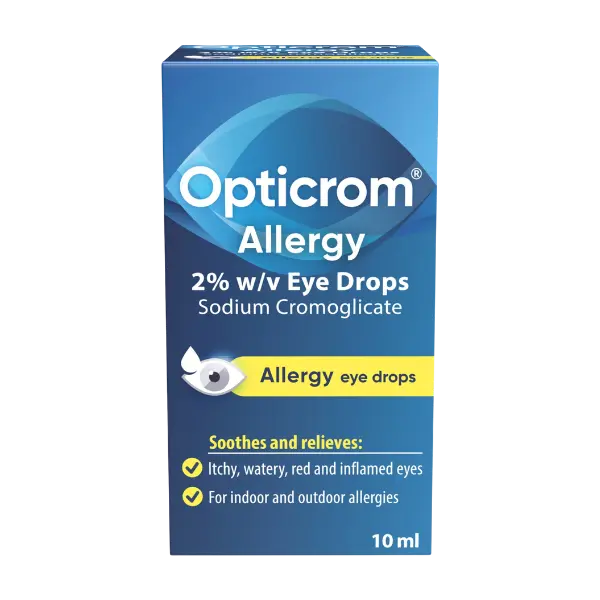
Opticrom Allergy Drops (10ml)
Effective eye drop treatment for the symptoms of allergies
- Powerful relief from allergy symptoms
- Contains sodium cromoglicate
- Easy to administer directly into the eye
- Provides fast-acting relief
- Gets to work in 2 minutes
£5.49 Available Free Delivery on Orders over £20!
In stock
| Strength | 2% |
| Size | 10ml |
Overview
How do Opticrom Allergy Drops (10ml) prevent the allergic immune response?
Opticrom Allergy Drops contain the active medicinal ingredient sodium cromoglicate, which belongs to a class of drugs known as mast cell stabilisers. To understand how Opticrom Allergy Drops work, it is necessary to understand the allergic mechanism within the eye. When an individual with an allergy comes into contact with a trigger, such as pollen, pet dander, or dust mites, the immune system activates specialised immune cells located in the eyelids and conjunctiva called mast cells. These mast cells undergo a process called degranulation, where the mast cells break open and release inflammatory chemicals, primarily histamine, into the surrounding tissue. This release of histamine causes the blood vessels to dilate, which leads to redness, swelling, and the intense itching sensation known as pruritus. Opticrom Allergy Drops work by strengthening the outer membrane of these mast cells. By stabilising the cell wall, Opticrom Allergy Drops prevent the mast cells from degranulating and releasing histamine, effectively stopping the allergic reaction at its source before the symptoms can fully develop.
Why is the regular application of Opticrom Allergy Drops (10ml) beneficial?
Because Opticrom Allergy Drops function by stabilising the mast cells rather than just blocking the histamine after it has been released, Opticrom Allergy Drops are particularly effective when used as a preventative measure. For sufferers of seasonal allergic conjunctivitis, also known as hay fever, using Opticrom Allergy Drops consistently throughout the pollen season helps to maintain the stability of the mast cells. This continuous protection means that even when the eyes are exposed to high levels of pollen, the immune response is dampened, and the symptoms are significantly reduced. Opticrom Allergy Drops provide control over the condition, allowing the user to manage their eye health proactively.
What specific symptoms do Opticrom Allergy Drops (10ml) treat?
Opticrom Allergy Drops are clinically indicated for the relief and treatment of allergic conjunctivitis. This condition involves inflammation of the conjunctiva, which is the clear membrane covering the white of the eye and the inner surface of the eyelids. Opticrom Allergy Drops effectively treat the primary symptoms of this condition, which include redness, excessive watering or tearing, and severe itching. Opticrom Allergy Drops also help to reduce the puffiness of the eyelids, known medically as oedema, which often accompanies a severe allergic reaction.
Active Ingredients
Sodium Cromoglicate
Usage Instructions
How to apply Opticrom Allergy Drops (10ml) correctly?
Opticrom Allergy Drops must be applied with care to ensure the solution covers the eye surface.
Application: The user should wash their hands thoroughly before use. Tilt the head backwards and gently pull down the lower eyelid to create a pocket. Squeeze the bottle gently to release one or two drops into each eye.
Frequency: The recommended dose is one or two drops instilled into each eye, four times a day.
Hygiene: It is critical that the dropper tip of the bottle does not touch the eye, the eyelid, or the surrounding skin, as this can contaminate the sterile solution remaining in the bottle.
Can Opticrom Allergy Drops (10ml) be used with contact lenses?
Opticrom Allergy Drops contain a preservative called benzalkonium chloride. This chemical is known to be absorbed by soft contact lenses, which can lead to discolouration of the lens and potential irritation to the cornea. Therefore, users must remove their contact lenses before applying Opticrom Allergy Drops. Users should wait for at least 15 minutes after instilling Opticrom Allergy Drops before reinserting their contact lenses to ensure the preservative has dispersed.
Warnings
When must Opticrom Allergy Drops (10ml) not be used?
Opticrom Allergy Drops must not be used by patients who have a known hypersensitivity or allergy to sodium cromoglicate or benzalkonium chloride. Opticrom Allergy Drops are intended solely for the treatment of allergic conjunctivitis and are not suitable for treating eye infections, such as bacterial conjunctivitis. If the user experiences eye pain, changes in vision, or if the redness increases despite using Opticrom Allergy Drops, the user should discontinue use and consult a medical professional immediately.
Safety advice regarding storage and shelf life of Opticrom Allergy Drops (10ml)?
Opticrom Allergy Drops are supplied as a sterile solution. Once the bottle is opened, the sterility can only be guaranteed for a limited period. Opticrom Allergy Drops must be discarded 28 days after first opening, even if there is solution remaining in the bottle. Using Opticrom Allergy Drops after this 28-day window increases the risk of bacterial contamination and subsequent eye infection. Opticrom Allergy Drops should be stored below 25°C and kept out of the sight and reach of children.
Who Is It For
Who are Opticrom Allergy Drops (10ml) suitable for?
Opticrom Allergy Drops are suitable for adults and children. Opticrom Allergy Drops are specifically designed for individuals suffering from acute or chronic allergic eye conditions, ranging from seasonal hay fever to perennial allergies caused by house dust mites or animal fur. Opticrom Allergy Drops are an ideal choice for patients who require a targeted, local treatment that acts directly on the eye tissues without affecting the rest of the body. Opticrom Allergy Drops are suitable for users who want to prevent their symptoms from flaring up during high pollen counts.
Alternatives
Common alternatives to Opticrom Allergy Drops (10ml)?
If Opticrom Allergy Drops are not suitable due to the preservative content or the mechanism of action, common alternatives include:
- Otrivine Antistin Eye Drops: A dual-action formula containing an antihistamine (antazoline) and a vasoconstrictor (xylometazoline), which provides more immediate relief for redness and itching than Opticrom Allergy Drops.
- Optrex Actimist 2 in 1 for Itchy Watery Eyes: A liposomal spray applied to closed eyelids that repairs the tear film barrier to block allergens, suitable for use with contact lenses.
- Catacrom Eye Drops: Another brand of sodium cromoglicate drops that works in the exact same way as Opticrom Allergy Drops to stabilise mast cells.
- Clarityn Allergy Tablets: An oral antihistamine containing loratadine that treats the systemic symptoms of hay fever, including itchy eyes, runny nose, and sneezing, offering a tablet alternative to eye drops.
At Elite Meds, we provide simple, reliable and fast delivery for all orders. We use Royal Mail exclusively, based on consistent performance and strong customer satisfaction across our website and eBay stores.
Delivery Options
Royal Mail Tracked 48 – £3.99
Royal Mail Tracked 24 – £4.49
Delivery timeframes are estimates provided by Royal Mail and are not guaranteed.
Dispatch Times
- Orders placed before 3pm Monday to Friday are dispatched the same working day.
- Orders placed after 3pm, on weekends or bank holidays are dispatched the next working day.
See our full delivery policy here
You May Like These
View All

Reviews (0.0/5 stars based on 0 reviews)
There are no reviews yet.