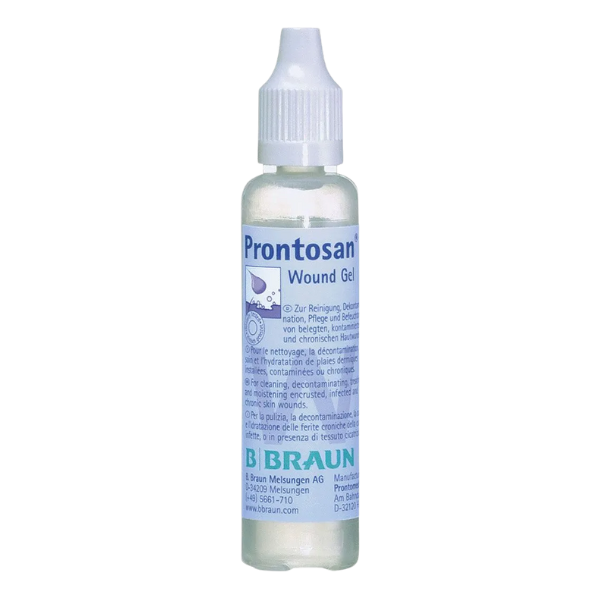
Prontosan Wound Gel (30ml)
Moisturising wound gel to cleanse and support natural healing
- Cleans and moisturises wounds to promote healing
- Contains polyhexanide and betaine for antimicrobial protection
- Prevents infection and supports natural tissue repair
- Suitable for chronic and acute wounds, cuts, and burns
- Gentle, non-sticky formula for comfortable use
£11.09 Available Free Delivery on Orders over £20!
In stock
| Size | 30 ml |
Overview
How does Prontosan Wound Gel (30ml) disrupt bacterial biofilm?
Prontosan Wound Gel is specifically engineered to tackle bioburden and biofilm, which are significant barriers to wound healing. A biofilm is a complex aggregation of bacteria embedded in a protective, slimy matrix of sugars and proteins that adheres firmly to the wound bed. Standard saline or water often fails to penetrate this shield. Prontosan Wound Gel contains Betaine, a highly effective surfactant (surface-active agent). Betaine works by lowering the surface tension of the fluid within the wound. This physical action loosens the adhesion of the biofilm, cellular debris, and foreign contaminants. By effectively breaking the bond between the bacteria and the tissue, Prontosan Wound Gel allows these harmful substances to be lifted and rinsed away during dressing changes, exposing the healthy tissue underneath.
What is the antimicrobial action of Polyhexanide in Prontosan Wound Gel (30ml)?
To prevent infection and reduce the bacterial load, Prontosan Wound Gel incorporates Polyhexanide (PHMB) at a concentration of 0.1%. Polyhexanide is a broad-spectrum antimicrobial agent. Unlike antibiotics that target specific bacterial processes, Polyhexanide works by binding to the negatively charged cell walls of bacteria. Upon contact, Prontosan Wound Gel destabilises the bacterial cell envelope, leading to the leakage of cytoplasmic contents and the death of the microorganism. This mechanism is effective against a wide range of pathogens, including multi-drug resistant strains like MRSA (Methicillin-Resistant Staphylococcus Aureus) and Pseudomonas aeruginosa, without damaging the patient’s healthy skin cells or stalling the healing process.
How does Prontosan Wound Gel (30ml) facilitate autolytic debridement?
Prontosan Wound Gel creates and maintains a moist wound environment, which is the optimal condition for healing. Dry wounds often develop a hard crust or scab (eschar) and dead tissue (slough) that impede new skin growth. Prontosan Wound Gel keeps the wound bed hydrated. This moisture supports autolytic debridement, a natural process where the body’s own enzymes soften and liquefy dead tissue so it can be separated from healthy tissue. Furthermore, the gel consistency of Prontosan Wound Gel acts as a barrier that prevents the secondary dressing from sticking to the wound surface. This ensures that when dressings are changed, the fragile new tissue (granulation tissue) is not torn away, thereby reducing pain and trauma for the patient.
Active Ingredients
Polyhexanide (0.1% polyhexamethylene biguanide / PHMB) and a betaine surfactant (0.1% undecylenamidopropyl betaine)
Usage Instructions
How to apply Prontosan Wound Gel (30ml) correctly?
Prontosan Wound Gel is for external use on wounds only.
- Cleaning: Before applying Prontosan Wound Gel, the wound should ideally be cleansed with a sterile solution (such as Prontosan Wound Irrigation Solution) to remove loose debris.
- Application: Apply a generous coating of Prontosan Wound Gel directly onto the wound bed. The layer should be approximately 3mm to 5mm thick.
- Cavities: For deep wounds or pockets, Prontosan Wound Gel can be filled loosely into the cavity.
- Dressing: Cover the area with a suitable secondary dressing (e.g., gauze, foam, or compress) to keep Prontosan Wound Gel in place.
- Frequency: Prontosan Wound Gel can be left on the wound until the next dressing change. The frequency of changes depends on the clinical condition of the wound but Prontosan Wound Gel remains active for several days.
Warnings
When must Prontosan Wound Gel (30ml) not be used?
Prontosan Wound Gel must not be used by patients with a known allergy or hypersensitivity to Betaine, Polyhexanide, or any other ingredients. Prontosan Wound Gel is not suitable for use on the central nervous system (brain and spinal cord) or the meninges. Prontosan Wound Gel must not be used in the middle or inner ear or strictly on hyaline cartilage (such as during knee surgery). Prontosan Wound Gel must not be used in the eyes; if contact occurs, the eyes should be rinsed thoroughly with saline.
What chemical interactions should be avoided?
Prontosan Wound Gel should not be combined with other wound cleansing soaps, ointments, oils, or enzymes. Specifically, anionic surfactants (often found in common soaps) or povidone-iodine can interact with the Polyhexanide in Prontosan Wound Gel, reducing its antimicrobial efficacy or causing discolouration.
Who Is It For
Who is Prontosan Wound Gel (30ml) suitable for?
Prontosan Wound Gel is suitable for patients of all ages, including infants, children, adults, and the elderly. Prontosan Wound Gel is specifically indicated for the management of acute and chronic wounds. This includes traumatic wounds like skin tears, grazes, and lacerations, as well as thermal wounds such as 1st and 2nd-degree burns. Prontosan Wound Gel is extensively used for chronic conditions like venous leg ulcers, diabetic foot ulcers, and pressure ulcers (bedsores). Prontosan Wound Gel is an ideal choice for patients with wounds that are slow to heal due to the presence of necrotic tissue or suspected infection.
Alternatives
Common alternatives to Prontosan Wound Gel (30ml)?
If Prontosan Wound Gel is not suitable due to availability or specific wound requirements, common alternatives include:
- Intrasite Gel: A hydrogel that effectively rehydrates necrotic tissue to aid debridement, suitable for dry, sloughy wounds but lacks the active antimicrobial component of Prontosan Wound Gel.
- Iodosorb Ointment: Contains cadexomer iodine to kill bacteria and absorb exudate, suitable for infected, weeping wounds, whereas Prontosan Wound Gel is better for hydrating dry wounds.
- Medihoney Medical Honey: Uses Manuka honey to lower wound pH and provide antibacterial action through osmosis, offering a natural alternative to the chemical agents in Prontosan Wound Gel.
- Inadine Dressing: A non-adherent dressing impregnated with povidone-iodine, suitable for protecting superficial wounds from infection without the need for a gel application.
At Elite Meds, we provide simple, reliable and fast delivery for all orders. We use Royal Mail exclusively, based on consistent performance and strong customer satisfaction across our website and eBay stores.
Delivery Options
Royal Mail Tracked 48 – £3.99
Royal Mail Tracked 24 – £4.49
Delivery timeframes are estimates provided by Royal Mail and are not guaranteed.
Dispatch Times
- Orders placed before 3pm Monday to Friday are dispatched the same working day.
- Orders placed after 3pm, on weekends or bank holidays are dispatched the next working day.
See our full delivery policy here
You May Like These
View All


Reviews (0.0/5 stars based on 0 reviews)
There are no reviews yet.