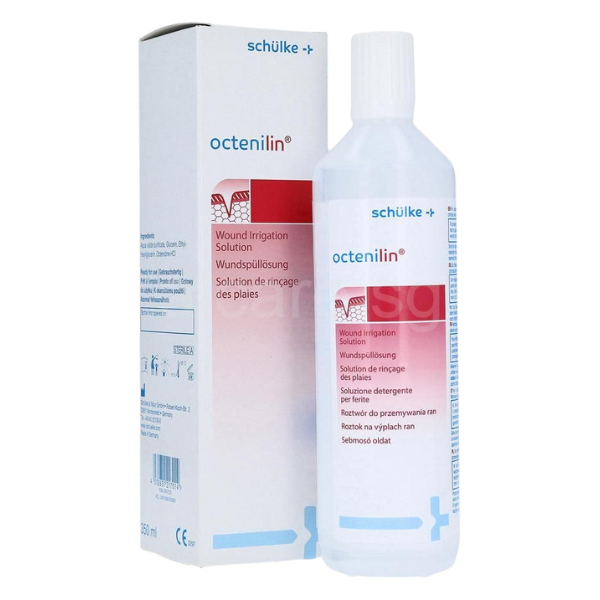
Octenilin Wound Irrigation Solution (350ml)
Ready to use wound irrigation to rinse and prepare dressings
- Cleanses wounds gently while reducing infection risk
- Contains octenidine and phenoxyethanol for antiseptic action
- Suitable for chronic wounds, ulcers, and surgical areas
- Supports a healthy healing environment
- Non-irritating formula safe for sensitive skin
£8.29 Available Free Delivery on Orders over £20!
In stock
| Size | 350 ml |
Overview
How does Octenilin Wound Irrigation Solution (350ml) disrupt bacterial biofilm?
Octenilin Wound Irrigation Solution is scientifically formulated to address the primary barrier to wound healing: the biofilm. A biofilm is a resilient community of bacteria that adhere to the wound bed by secreting a protective, slimy matrix of polysaccharides and proteins. Standard saline often fails to penetrate this barrier. Octenilin Wound Irrigation Solution contains ethylhexylglycerin, which acts as a powerful surfactant. This surfactant works by significantly lowering the surface tension of the fluid. By reducing the surface tension, Octenilin Wound Irrigation Solution can penetrate the microscopic crevices, fissures, and wound pockets that water cannot reach. This physical action undercuts and loosens the biofilm, as well as necrotic tissue (dead skin) and debris, allowing these contaminants to be flushed away gently without traumatising the healthy tissue underneath.
What is the antimicrobial profile of Octenidine in Octenilin Wound Irrigation Solution (350ml)?
The cleansing power of Octenilin Wound Irrigation Solution is enhanced by the presence of octenidine dihydrochloride. This is a cationic antiseptic agent that provides a broad spectrum of antimicrobial activity. When Octenilin Wound Irrigation Solution comes into contact with pathogens, the octenidine molecule binds to the negatively charged cell envelopes of bacteria and fungi. This binding destabilises the cell membrane, disrupting its structural integrity and causing the microorganism to perish. Octenilin Wound Irrigation Solution is effective against a wide range of problematic organisms, including multi-drug resistant strains such as Methicillin-Resistant Staphylococcus aureus (MRSA) and Vancomycin-Resistant Enterococci (VRE), helping to reduce the bioburden that leads to infection.
How does Octenilin Wound Irrigation Solution (350ml) facilitate painless dressing changes?
Changing dressings on chronic or dry wounds can be a source of significant pain and trauma if the dressing has adhered to the wound bed. Removal of a stuck dressing can tear away fragile new granulation tissue, setting back the healing process. Octenilin Wound Irrigation Solution is designed to be fully compatible with wound dressings. By saturating the dressing with Octenilin Wound Irrigation Solution before removal, the solution lubricates the interface between the fabric and the skin. This moistening action softens any dried exudate or scabs, allowing the dressing to be lifted away easily and without pain. This creates a moist wound environment, which is physiologically optimal for the migration of epithelial cells and rapid healing.
Active Ingredients
Octenidine dihydrochloride
Usage Instructions
How to apply Octenilin Wound Irrigation Solution (350ml) for wound cleansing?
Octenilin Wound Irrigation Solution is for external topical use.
- Irrigation: Octenilin Wound Irrigation Solution should be poured directly onto the wound from the bottle. The wound should be rinsed thoroughly to flush out loose debris and bacterial deposits.
- Swabbing: If mechanical cleaning is required, sterile gauze soaked in Octenilin Wound Irrigation Solution can be used to gently wipe the wound bed.
- Soaking: For encrusted wounds, gauze saturated with Octenilin Wound Irrigation Solution can be placed over the wound for several minutes to soften the necrotic tissue (slough) before removal.
- Frequency: Octenilin Wound Irrigation Solution should be used during every dressing change to ensure the wound bed remains clean and conducive to healing.
Can Octenilin Wound Irrigation Solution (350ml) be used continuously?
Yes, Octenilin Wound Irrigation Solution can be used for repetitive and long-term wound management. Unlike some antiseptics that can delay healing or cause tissue toxicity with prolonged use, Octenilin Wound Irrigation Solution is non-cytotoxic to human keratinocytes and fibroblasts, meaning it cleanses without damaging the cells responsible for skin repair.
Warnings
When must Octenilin Wound Irrigation Solution (350ml) not be used?
Octenilin Wound Irrigation Solution must not be used by patients with a known allergy or hypersensitivity to octenidine dihydrochloride or ethylhexylglycerin. Octenilin Wound Irrigation Solution must not be used for infusion or injection into the bloodstream. Octenilin Wound Irrigation Solution acts locally and must not be swallowed. Octenilin Wound Irrigation Solution must not be applied to hyaline cartilage (such as during knee surgery) or introduced into the meninges or middle ear.
Who Is It For
Who is Octenilin Wound Irrigation Solution (350ml) suitable for?
Octenilin Wound Irrigation Solution is suitable for use in newborns, infants, children, adults, and the elderly. Octenilin Wound Irrigation Solution is specifically indicated for the cleansing and moistening of chronic skin wounds, such as venous leg ulcers, diabetic foot ulcers, and pressure sores. Octenilin Wound Irrigation Solution is an ideal choice for the management of acute traumatic wounds, lacerations, and minor burns. Octenilin Wound Irrigation Solution is suitable for patients with sensitive skin or those who find iodine-based or chlorhexidine-based products irritating, as it is hypoallergenic and painless upon application.
Alternatives
Common alternatives to Octenilin Wound Irrigation Solution (350ml)?
If Octenilin Wound Irrigation Solution is not suitable due to availability or specific clinical needs, common alternatives include:
- Prontosan Wound Irrigation Solution: Contains betaine and polyhexanide, offering a very similar mechanism of action to Octenilin Wound Irrigation Solution for disrupting biofilm and cleansing wounds.
- Clinisept+ Skin Cleanser: Uses hypochlorous acid technology to provide rapid antimicrobial action and skin cleansing without the use of surfactants like those in Octenilin Wound Irrigation Solution.
- Normasol (Sterile Saline): Standard 0.9% sodium chloride solution used for mechanical rinsing of wounds, suitable for simple cleaning but lacks the active biofilm-disrupting properties of Octenilin Wound Irrigation Solution.
- Microdacyn Wound Care Solution: An electrolysed water solution (super-oxidised) that reduces microbial load and inflammation, suitable for acute and chronic wounds.
- Irripod Sodium Chloride: Individual pods of saline solution for single-use irrigation, suitable for minor first aid where the larger volume of Octenilin Wound Irrigation Solution is not required.
At Elite Meds, we provide simple, reliable and fast delivery for all orders. We use Royal Mail exclusively, based on consistent performance and strong customer satisfaction across our website and eBay stores.
Delivery Options
Royal Mail Tracked 48 – £3.99
Royal Mail Tracked 24 – £4.49
Delivery timeframes are estimates provided by Royal Mail and are not guaranteed.
Dispatch Times
- Orders placed before 3pm Monday to Friday are dispatched the same working day.
- Orders placed after 3pm, on weekends or bank holidays are dispatched the next working day.
See our full delivery policy here
You May Like These
View All


Reviews (0.0/5 stars based on 0 reviews)
There are no reviews yet.