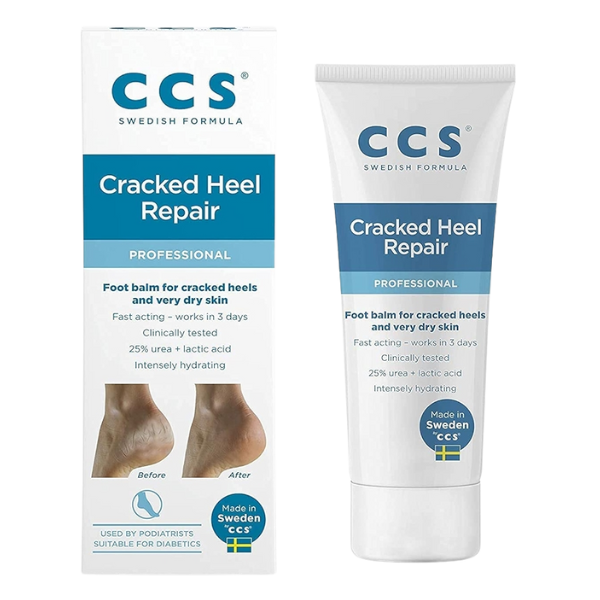
CCS Cracked Heel Repair Balm (125g)
Concentrated foot balm to soften hard skin and repair cracked heels
- Repairs and softens rough, cracked heels effectively
- Contains urea to exfoliate and hydrate thickened skin
- Improves skin elasticity and smoothness with regular use
- Absorbs quickly without leaving a greasy feel
- Clinically tested and suitable for diabetics
£8.99 Available Free Delivery on Orders over £20!
In stock
| Size | 125 g |
Overview
How does CCS Cracked Heel Repair Balm (125g) exfoliate thickened skin?
CCS Cracked Heel Repair Balm is chemically formulated to tackle the thick, hard skin (callus) that forms on heels. The primary active ingredient is Urea at a high concentration of 25%. At this specific strength, Urea acts as a potent keratolytic agent. The skin on the heels often becomes hyperkeratotic, meaning the outer layer of protein (keratin) becomes excessively thick and hard. CCS Cracked Heel Repair Balm works by breaking down the hydrogen bonds that hold these keratin cells together. This chemical action dissolves the “glue” between the dead skin cells, allowing the hard, yellow callus to be shed or filed away easily. By exfoliating this dead layer, CCS Cracked Heel Repair Balm reveals the softer, healthier skin underneath and reduces the pressure that causes cracks to deepen.
How does the high Urea concentration in CCS Cracked Heel Repair Balm (125g) hydrate?
Beyond its exfoliating properties, Urea is a natural humectant, meaning it has a strong affinity for water. In dry, cracked heels, the skin lacks the natural moisturising factors needed to retain elasticity. The 25% Urea in CCS Cracked Heel Repair Balm penetrates deep into the outer skin layer and binds water molecules within the skin cells. This intense hydration restores the skin’s flexibility. When the skin is supple, it can stretch rather than split under the pressure of walking, thereby allowing existing cracks (fissures) to heal and preventing new ones from forming.
What is the role of Lactic Acid in CCS Cracked Heel Repair Balm (125g)?
CCS Cracked Heel Repair Balm also contains Lactic Acid, an Alpha Hydroxy Acid (AHA). Lactic Acid works synergistically with Urea to enhance the exfoliation process. It lowers the pH of the skin slightly, which helps to further loosen the bonds between dead skin cells. Additionally, Lactic Acid stimulates the synthesis of ceramides in the skin barrier. By strengthening the skin’s natural lipid barrier, CCS Cracked Heel Repair Balm ensures that the moisture provided by the Urea is locked in, providing long-term protection against dehydration and infection.
Active Ingredients
Urea, Lactic Acid
Usage Instructions
How to apply CCS Cracked Heel Repair Balm (125g) correctly?
CCS Cracked Heel Repair Balm is for external use on the feet only.
- Preparation: For best results, wash and dry the feet before application. Applying CCS Cracked Heel Repair Balm after a bath or shower is ideal as the skin is softer.
- Application: Massage CCS Cracked Heel Repair Balm into the heels and any other dry, hard areas of the foot.
- Dosage: Use CCS Cracked Heel Repair Balm twice daily, morning and night.
- Maintenance: Once the cracks have healed and the skin is smooth, the frequency can be reduced to once daily or a few times a week to maintain the results.
- Hygiene: Wash hands thoroughly after applying CCS Cracked Heel Repair Balm.
Can CCS Cracked Heel Repair Balm (125g) be used on open wounds?
No, CCS Cracked Heel Repair Balm contains a high concentration of Urea and Lactic Acid. If applied to deep, open, or bleeding cracks (fissures) that expose the dermis, it will cause stinging and irritation. CCS Cracked Heel Repair Balm should be applied to the surrounding hard skin to soften it, but direct application into a bleeding wound should be avoided until the wound has started to close.
Warnings
When must CCS Cracked Heel Repair Balm (125g) not be used?
CCS Cracked Heel Repair Balm must not be used by children under 12 years of age. CCS Cracked Heel Repair Balm must not be used by patients with a known hypersensitivity to Urea or any of the other ingredients. CCS Cracked Heel Repair Balm must not be applied to broken, bleeding, or infected skin. Avoid contact with the eyes and mucous membranes. If irritation occurs, discontinue use immediately.
Does CCS Cracked Heel Repair Balm (125g) make feet slippery?
Yes, like many intense moisturisers, CCS Cracked Heel Repair Balm can leave a film on the skin until fully absorbed. Care must be taken when walking on smooth surfaces (like tiled floors) or wearing open shoes immediately after application to avoid slipping. It is often recommended to wear cotton socks after applying CCS Cracked Heel Repair Balm to aid absorption and prevent slipping.
Who Is It For
Who is CCS Cracked Heel Repair Balm (125g) suitable for?
CCS Cracked Heel Repair Balm is suitable for adults and children aged 12 years and over. CCS Cracked Heel Repair Balm is specifically indicated for individuals suffering from extremely dry, rough, or cracked heels. CCS Cracked Heel Repair Balm is an ideal choice for patients with diabetes, as maintaining healthy foot skin is critical to preventing diabetic foot ulcers (though diabetics should always check with a podiatrist before using high-strength exfoliants). CCS Cracked Heel Repair Balm is suitable for athletes or people who stand for long periods, leading to callus build-up.
Alternatives
Common alternatives to CCS Cracked Heel Repair Balm (125g)?
If CCS Cracked Heel Repair Balm is not suitable due to the high urea content or texture, common alternatives include:
- Flexitol Heel Balm: Contains 25% Urea like CCS Cracked Heel Repair Balm but in a thicker, paste-like base, often preferred for filling deep cracks.
- Scholl Cracked Heel Repair Cream: Contains Active Repair K+, a keratin-based ingredient, offering a different mechanism of action to the Urea in CCS Cracked Heel Repair Balm.
- O’Keeffe’s Healthy Feet: A highly concentrated, glycerin-based cream that creates a barrier to seal in moisture, suitable for those who find Urea products like CCS Cracked Heel Repair Balm stingy.
- Neutrogena Norwegian Formula Foot Cream: A milder, glycerin-rich formula suitable for general dry skin on the feet rather than the severe callus treatment provided by CCS Cracked Heel Repair Balm.
- CCS Foot Care Cream: A lower strength version (typically 10% Urea) from the same brand, suitable for daily maintenance once the severe cracks have been treated with CCS Cracked Heel Repair Balm.
At Elite Meds, we provide simple, reliable and fast delivery for all orders. We use Royal Mail exclusively, based on consistent performance and strong customer satisfaction across our website and eBay stores.
Delivery Options
Royal Mail Tracked 48 – £3.99
Royal Mail Tracked 24 – £4.49
Delivery timeframes are estimates provided by Royal Mail and are not guaranteed.
Dispatch Times
- Orders placed before 3pm Monday to Friday are dispatched the same working day.
- Orders placed after 3pm, on weekends or bank holidays are dispatched the next working day.
See our full delivery policy here



Reviews (0.0/5 stars based on 0 reviews)
There are no reviews yet.